


Solar Paradigm delivered a 300 kW rooftop solar system for Santos Coffee in Riverwood, Sydney. Installed, commissioned and energised, the system brings on-site solar generation into the business’s daily energy mix and is expected to generate approximately 438,000 kWh per year.
300 kW
Installed solar capacity
Commissioned and energised
438,000 kWh
Expected generation / year
438 MWh of solar electricity
≈263 tonnes
Indicative CO₂-e benefit / year
Compared with average NSW grid electricity
≈4,380 trees
Annual carbon uptake equivalent
EPA urban-tree model; no planting claim

Equipment used
Trina Solar panels
484 × 620 W solar modules.
Sungrow inverters
3 × SG110CX-P2 inverters, each rated at 110 kW.
SunLock mounting
Roof mounting and racking supporting the solar array.
Sungrow monitoring
Sungrow datalogger connected to iSolarCloud for system monitoring.
Solar during the working day
For a commercial site, the value of solar depends on when electricity is generated and when the business uses it. Santos Coffee’s monitoring snapshot shows daytime demand rising alongside solar production, allowing solar to supply a substantial share of the site’s electricity needs during generating hours.
When solar output exceeds the site’s demand, surplus electricity can flow to the grid. Grid supply continues to support the business outside solar-generating hours and whenever demand exceeds solar output.
A day on the system: 9 October 2026
The monitoring graph shows solar generation building through the morning and peaking at approximately 240 kW around midday. During parts of the day, solar output exceeds the site load; the negative grid trace is consistent with surplus electricity being exported.
Rises through the morning and eases towards evening.
Shows the business’s changing electricity load.
Shows imports and periods consistent with export.
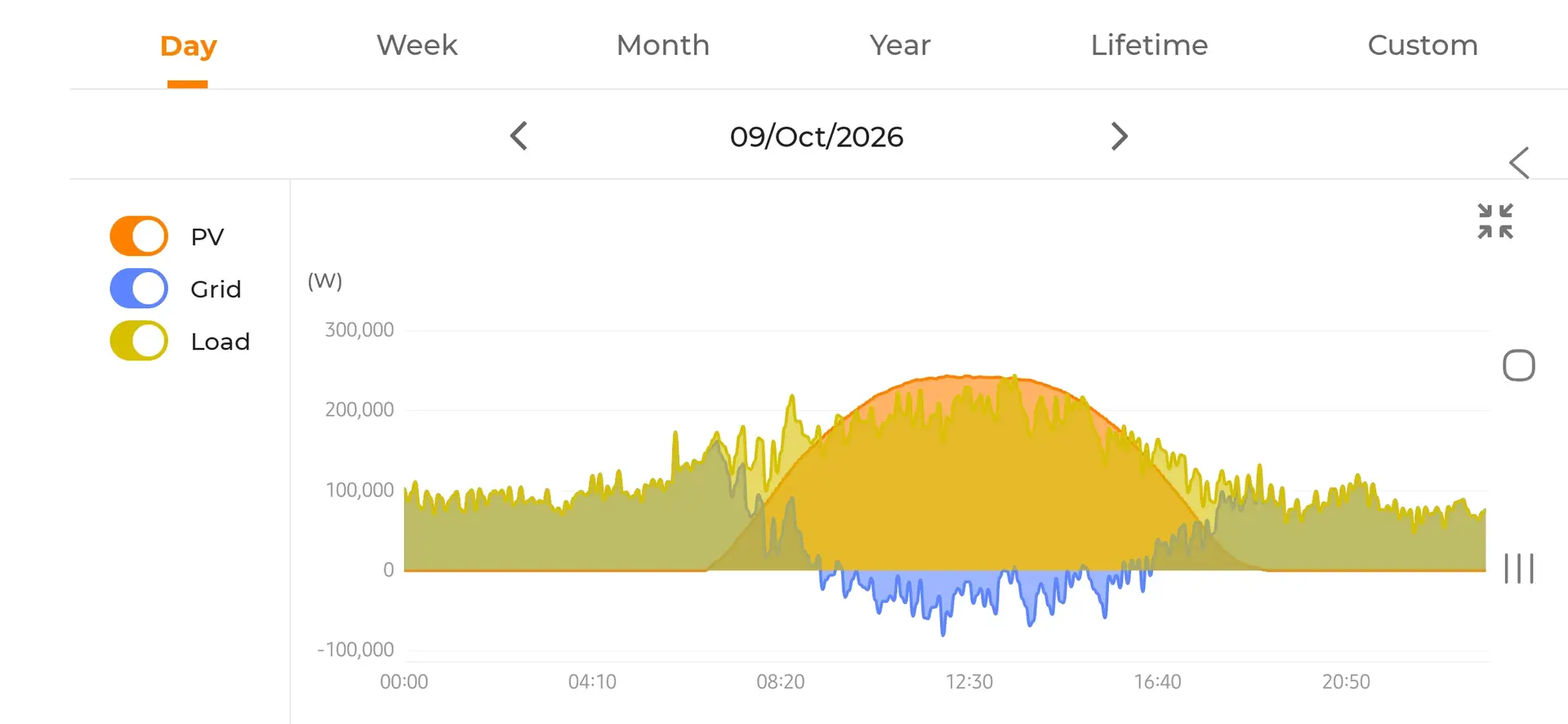
This graph shows power at points during one day. The approximately 240 kW peak is separate from the 300 kW installed array capacity. Annual energy generation is a forecast, not a total measured from this screenshot.
From rooftop installation to ongoing insight
✓ Commercial rooftop delivery
A completed 300 kW installation at a working business site.
✓ Commissioned and energised
The system is operating, with a production snapshot available for review.
✓ Performance visibility
Monitoring brings solar output, site demand and grid exchange into one view.
Expected environmental benefit
At the forecast annual output, the system has an indicative grid-emissions benefit of approximately 263 tonnes of CO₂-e per year. For perspective, that is comparable to the annual average carbon uptake of approximately 4,380 urban trees under the US EPA’s benchmark.
These are forecast comparisons. They are not measured emissions savings or a claim that trees have been planted.
How the estimates are calculated
Generation: 438,000 kWh/year is Solar Paradigm’s production forecast.
Emissions: 438,000 × 0.60 ÷ 1,000 = 262.8 tonnes CO₂-e/year. The 0.60 kg CO₂-e/kWh factor is the NSW/ACT location-based Scope 2 electricity factor in DCCEEW’s 2026 National Greenhouse Accounts Factors, Table 1.
This assumes forecast solar production displaces electricity with that average grid intensity, whether consumed on site or exported. It is a grid-emissions comparison, not a measured reduction in Santos Coffee’s own emissions inventory, a market-based renewable electricity claim or a lifecycle assessment. Actual output varies with weather, system availability and operating conditions; future grid factors can change.
Tree equivalent: 262.8 ÷ 0.060 = 4,380 trees. EPA’s annual-average urban-tree uptake benchmark is 60 kg CO₂ per tree per year, averaged over the first ten years of growth. This is an illustrative annual uptake equivalent, not an Australian planting or reforestation estimate. Species, location, growth and survival affect actual uptake.
DCCEEW: National Greenhouse Accounts Factors 2026, Table 1
US EPA: urban-tree equivalency methodology
What could solar do for your business?
Start with your electricity bills and, where available, interval consumption data. Solar Paradigm can assess your energy use, roof space and connection requirements to prepare a commercial solar proposal suited to your site.
Request a commercial solar assessmentExplore commercial solar

